Barcode, RFID or NFC — which technology identifies goods, containers and people most efficiently? The honest answer: it depends. Each of the three has a clear application profile, and in many businesses a combination turns out to be the best solution. Here is a practical comparison.

The barcode is by far the cheapest identification technology: the “label” is simply printed ink and costs practically nothing. Every retail product already carries an EAN code, so the infrastructure is universally in place. The limitations: a scanner needs a direct line of sight to the code, reads only one code at a time, and a damaged or dirty label quickly becomes unreadable. The data cannot be changed after printing — a printed code stays what it is.
RFID (Radio-Frequency Identification) transmits an identifier by radio between a transponder (tag) and a reader. Range and application differ greatly depending on the frequency band:
That bulk-reading capability is exactly what makes UHF RFID so attractive in the warehouse: a stocktake that takes days with a barcode scanner shrinks to hours with RFID, and goods-in can be registered by walking a pallet through a gate instead of scanning carton by carton. On the other side of the equation are tag costs from a few cents to several euros — and physics: metal surroundings and liquids dampen the radio signal and call for special on-metal tags. RFID tags are also rewritable, which makes them ideal for reusable containers and load carriers. For a deeper introduction, see our article A Few Words About RFID Technology.
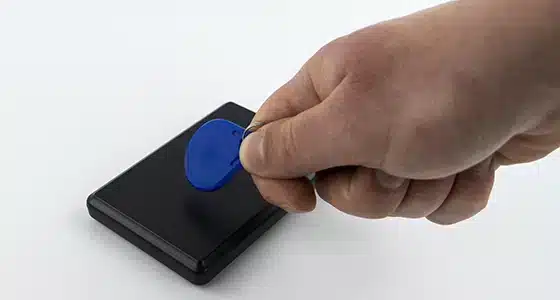
NFC (Near Field Communication) is technically a special case of HF RFID (13.56 MHz) with a deliberately short range of a few centimetres. Its trump card: virtually every modern smartphone has NFC built in. That makes the technology a natural fit wherever people interact with everyday devices — contactless payment, digital business cards, device pairing, product information at the shelf, or clocking in at a terminal with a card or fob. For bulk identification in the warehouse, however, NFC is unsuitable: the range is too short and there is no bulk reading.
| Barcode | RFID (UHF) | NFC | |
|---|---|---|---|
| Cost per label/tag | virtually zero | cents to euros | cents |
| Range | line of sight required | up to several metres | a few centimetres |
| Bulk reading | no | yes (hundreds of tags) | no |
| Rewritable | no | yes | yes |
| Robustness | sensitive (print quality) | high, except metal/liquids | high |
| Infrastructure cost | low | medium to high | low |
Barcode, RFID and NFC are not competitors but tools for different jobs: the barcode identifies products at unbeatable cost, UHF RFID accelerates bulk processes in the warehouse, NFC connects the physical world with the smartphone — and LF RFID reliably opens doors and clocks working hours. In our RFID, barcode scanners and access control categories you will find the right hardware for each of the three scenarios.