After roughly 50 years of the barcode, retail is preparing for its biggest transition since the introduction of the EAN code. Under the banner GS1 Sunrise 2027, the industry worldwide is getting ready to process 2D codes at the checkout alongside the classic barcode. High time, then, to put the two code worlds side by side — and to clarify what the transition means for your business.

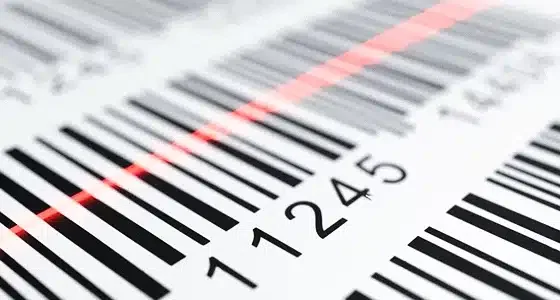
One-dimensional codes — above all the EAN-13 on packaging, plus Code 128 and Code 39 in warehousing and logistics — encode information in bars and gaps of varying width. They are cheap to print, robust and proven millions of times over. Their limitation: they store only a short string of characters, in practice usually a plain item number (GTIN). Everything else — price, shelf life, batch — has to come from a downstream system. If you want to go deeper into the basics, see our articles Barcodes — Everything You Should Know About Them and Generating barcodes.
Two-dimensional codes store information in a dot matrix — and therefore orders of magnitude more:
The initiative by the standards organisation GS1 pursues a clear goal: by the end of 2027, retail checkout systems worldwide should be able to process 2D codes — specifically QR codes with GS1 Digital Link and GS1 DataMatrix — in addition to the EAN barcode. During a transition phase products will carry both codes; in the long term the 2D code can replace the barcode entirely.
The benefit is obvious: a single code on the packaging will then contain not only the GTIN but also, for example, the best-before date, batch and serial number — and can simultaneously act as a web link to product information, provenance data or recipes. For retail this opens up automatic freshness control at the checkout (expired goods are flagged), more precise recalls and better traceability; for consumers, more transparency with a smartphone scan.
The most important point concerns hardware: classic laser scanners can only read 1D barcodes. 2D codes require a camera-based scanner — a so-called 2D imager. Anyone buying scanners today should therefore consistently choose 2D-capable devices: the price difference has become small, and the devices of course continue to read all common 1D codes as well.
A 2D imager also brings tangible everyday advantages:
In our barcode readers and scanners category you will find a wide selection of 2D imagers — wired, wireless and as stationary presentation scanners for the checkout.
The barcode will not disappear overnight — but the direction is clear: 2D codes are becoming the new standard in retail. If you already choose 2D imagers for upcoming purchases, you are ready for Sunrise 2027, can process display codes and pharmaceutical serialisation marks, and save yourself an expensive second wave of upgrades. In short: there is hardly any reason left to buy a 1D-only scanner today.